Does losing weight raise your VO2 max?
On this page
Your number goes up, but your engine doesn’t. VO2 max is per kilogram, so losing 10 percent of your weight raises it about 11 percent with the same heart and lungs. Only training raises the liters of oxygen your body can use.
What we’d do
Count weight loss as a real gain in what you can do, since you carry less up every hill, but don’t count it as a fitter heart. If you’re losing weight, keep the cardio going and lift twice a week, so the loss comes mostly from fat and your engine grows while the car gets lighter. On a GLP-1 drug like Ozempic or Zepbound that’s even more important, because a big share of the weight lost can be lean mass.
If you remember three things
- The number is oxygen divided by weight. Change either one and it moves.
- 10 percent lighter is about 11 percent higher. With no change at all in your heart.
- On GLP-1 drugs, 25 to 40 percent of the weight lost is fat-free mass. And studies so far haven’t shown a gain in fitness.
Why does my VO2 max go up when I diet?
Lots of people see it. They start losing weight, they haven’t changed their workouts at all, and their watch says their VO2 max is climbing. It feels like proof that they’re getting fitter.
Part of it is real and part of it is arithmetic. VO2 max is usually given per kilogram of body weight. Your watch also uses the weight you entered in your profile, along with your age, sex and height (Apple says so for Apple Watch). Change the weight and the number changes, even if your heart hasn’t.
Same engine, lighter car
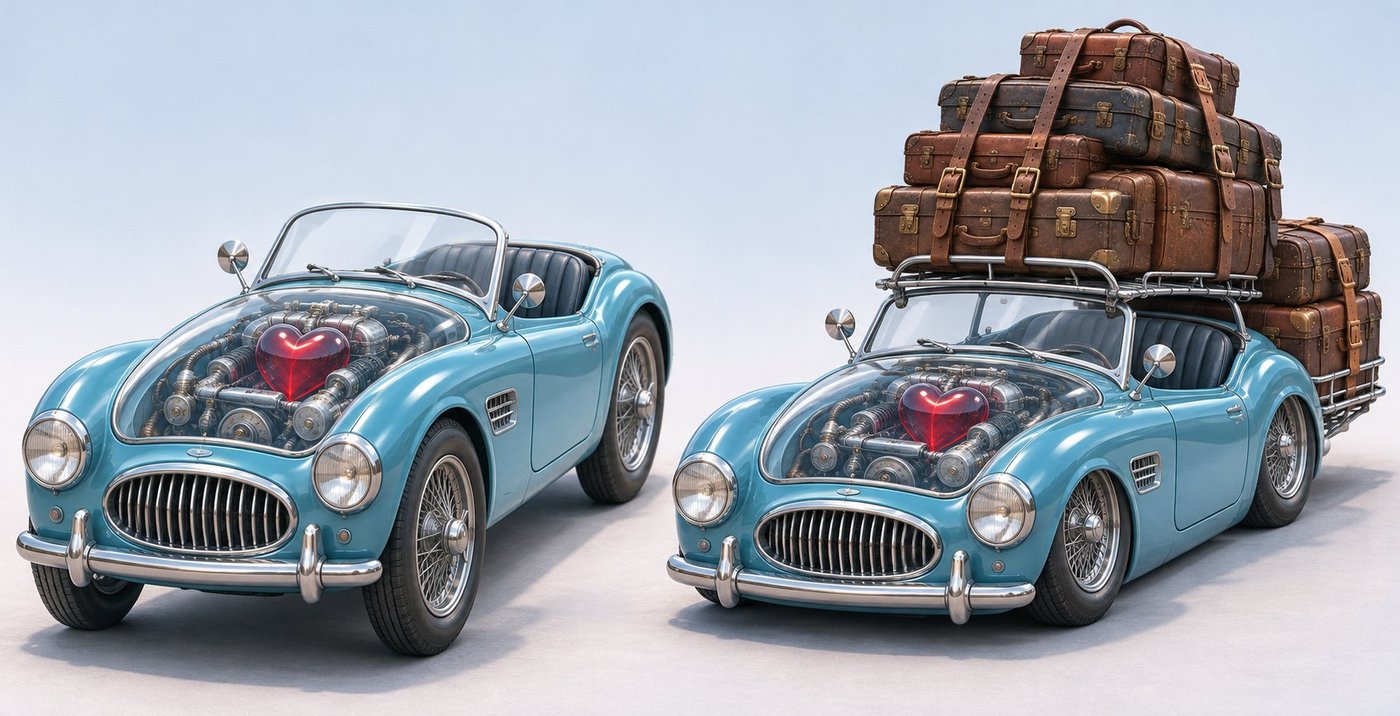
A car’s top speed up a hill depends on its engine and how much it weighs. Take 200 pounds of luggage out of the trunk and it climbs faster, with the same engine.
That’s exactly what happens to VO2 max. Your heart and muscles can use a certain number of liters of oxygen a minute. That’s the engine. Divide by your weight in kilograms and you get ml/kg/min, the number on the chart. Lose weight and you divide by a smaller number.
Here’s how it works out. Take a 200 lb man in his 40s with a VO2 max of 35, about the 49th percentile for his age. His engine is about 3.2 liters a minute. If he drops to 180 lb and his heart doesn’t change at all, the same 3.2 liters divided by his new weight is 38.9, about the 63rd percentile. He went up 14 percentile points without one workout.
The rule of thumb is simple. Lose 10 percent of your weight and the number rises about 11 percent (1 divided by 0.9), with the same engine.
The Dallas men, in reverse
The best real example runs the other way. In 1966, five healthy 20-year-old men in Dallas were tested for a bed rest study. Thirty years later, at 50, researchers tested them again.
| At 20 (1966) | At 50 (1996) | At 50, after six months of training | |
|---|---|---|---|
| Weight | 77 kg (170 lb) | 100 kg (220 lb) | |
| Bodyfat | 14 percent | 28 percent | |
| Engine, liters of oxygen a minute | 3.30 | 2.90 | 3.3 |
| VO2 max, ml/kg/min | 43 | 31 | 36 |
Their engine had lost only 11 percent in 30 years. Their per-kilogram number had lost 28 percent, because they were carrying 23 more kilos, most of it fat (their fat-free mass went from 66 to 72 kg). Then six months of training brought the engine all the way back to 3.3 liters a minute, but per kilogram they reached 36, not 43, because most of the extra weight stayed.
Training rebuilt the engine. To get back to 43 with that same engine, they’d have needed to weigh what they did at 20.
Is the gain from weight loss fake, then?
No. You really can do more. Carrying less weight up a flight of stairs or a trail takes less of your engine, so it feels easier. Anyone who’s taken off a heavy hiking pack halfway up a hill knows the feeling, with the same legs and lungs and an easier climb. A higher per-kilogram number is a fair description of that.
It doesn’t mean a stronger heart, though. In healthy people, VO2 max is capped by how much oxygen your heart and blood can deliver, and training raises it mainly by raising the heart’s output (Bassett and Howley, 2000). In the 4x4 trial, stroke volume rose about 10 percent after interval training. Losing weight doesn’t do that. If your liters a minute aren’t rising, your heart isn’t changing.
Both count, for different things. Weight loss raises the number on the chart and makes moving easier. Training raises the engine. Do both and you get both.
What about GLP-1 drugs like Ozempic?
GLP-1 drugs (semaglutide, sold as Ozempic and Wegovy) and the newer GLP-1 and GIP drugs (tirzepatide, sold as Mounjaro and Zepbound) cause large weight loss. On paper, that should push VO2 max up per kilogram.
A 2025 review found two catches. First, about 25 to 40 percent of the weight lost on these drugs comes from fat-free mass, which includes muscle. That’s far faster than people lose fat-free mass with age. Second, clinical studies so far haven’t shown that the drugs improve cardiorespiratory fitness. The authors say more research is needed to know what the drugs do to fitness over the long run.
Muscle is where the oxygen gets used, so losing a lot of it is the wrong direction for your engine, even if the per-kilogram number rises. That’s why we’d pair a GLP-1 drug with cardio most days and lifting twice a week, the muscle-strengthening part of the US guideline, plus enough protein. bodyfat.guide covers how GLP-1 drugs work, whether they make you lose muscle and how much protein you need. Never change a medicine without your doctor. If you’d rather start without a gym, how to increase VO2 max naturally has walks, stairs and hills.
How do you tell the two apart?
Watch your liters a minute, not only ml/kg/min. Multiply your VO2 max by your weight in kilograms and divide by 1,000. If that number rises, your engine grew. If only the per-kilogram number rose, it was the scale.
Two more things help:
- Keep your weight current in your watch’s settings. An old weight gives an old answer.
- Retest with a field test that doesn’t care about your profile. A 12-minute run or a 1-mile walk at your new weight shows what you can actually do. How to measure it has the tests.
Try it
Enter your weight and your VO2 max, then slide the weight. The liters a minute stay flat while the number on the chart moves.
What your result means, and what to do next
- Losing weight raises the number. Every hill gets easier, because you carry less up it.
- The engine stays the same size. Only training raises the liters of oxygen your heart and muscles can use.
- Keep the cardio while you lose weight, and lift twice a week, so the loss comes mostly from fat. Weight and VO2 max
- No gym? Start with walks, stairs and hills. If you want to, and if you can, the natural way builds both layers. How to increase VO2 max naturally
- Retest the same way in 8 to 12 weeks. Same test, same route or same watch. Believe a change of more than 2 to 4 points.
8 sources
- McGuire DK and others, A 30-year follow-up of the Dallas Bedrest and Training Study: I. Effect of age on the cardiovascular response to exercise, Circulation, 2001europepmc.org
- McGuire DK and others, A 30-year follow-up of the Dallas Bedrest and Training Study: II. Effect of age on cardiovascular adaptation to exercise training, Circulation, 2001europepmc.org
- Liu Z, Weeldreyer NR and Angadi SS, Incretin receptor agonism, fat-free mass, and cardiorespiratory fitness: a narrative review, Journal of Clinical Endocrinology and Metabolism, 2025pmc.ncbi.nlm.nih.gov
- Kaminsky LA and others, Updated reference standards for cardiorespiratory fitness measured with cardiopulmonary exercise testing (FRIEND), Mayo Clinic Proceedings, 2022mayoclinicproceedings.org
- Apple Support, Track your cardio fitness levels, published 2026-09-14support.apple.com
- Bassett DR and Howley ET, Limiting factors for maximum oxygen uptake and determinants of endurance performance, Medicine and Science in Sports and Exercise, 2000europepmc.org
- Helgerud J and others, Aerobic high-intensity intervals improve VO2max more than moderate training, Medicine and Science in Sports and Exercise, 2007europepmc.org
- Centers for Disease Control and Prevention, Adult activity: an overview, checked 2026-11-14cdc.gov