What does VO2 max actually measure?
On this page
VO2 max is the most oxygen your body can take in and use in one minute at full effort, measured in milliliters per kilogram of body weight per minute (ml/kg/min). In healthy people the heart’s output sets the ceiling, and training raises VO2 max mainly by making the heart pump more blood.
What we’d do
Think of VO2 max as your heart’s top output, shared out over your body weight. That tells you what to train. Steady cardio most days builds the base, and one or two sessions a week that keep your heart near its limit for a few minutes at a time push the ceiling up. Skip the gadgets that promise bigger lungs, since training raises VO2 max through the heart and the blood.
If you remember three things
- VO2 max is a delivery number. It’s how much oxygen your heart and blood can get to working muscle, per kilogram of you.
- The heart grows with training. After eight weeks of intervals, fit young men’s hearts pumped about 10 percent more blood per beat.
- It’s power to weight. The liters of oxygen are the engine. Your weight is the car.
Isn’t VO2 max about your lungs?
That’s the first guess almost everyone makes. The name has oxygen in it, oxygen comes in through your lungs, and when you run hard it’s your breathing that feels like it’s about to give out, so it seems obvious that a big VO2 max means big lungs.
In healthy people the limit is mostly further down the line, in how much oxygen-filled blood your heart can pump out each minute, and training raises VO2 max by raising that. Your breathing is what you notice, but the heart is what sets the number.
Who first measured it?
The idea came from a man who also won a Nobel Prize. The British physiologist A. V. Hill shared the 1922 Nobel Prize for Physiology or Medicine for work on how muscle makes energy with and without oxygen. He was keen on athletics, so he took the question out of the lab. In the 1920s Hill and his colleagues measured the oxygen used by themselves and other runners as they ran around an 85-meter grass track. Along the way they coined the term “maximum O2 intake”.
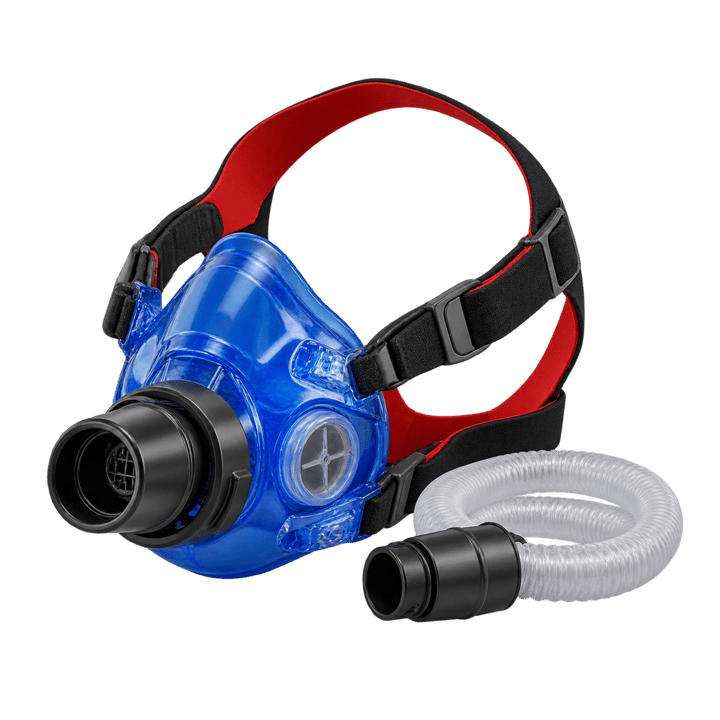
A century later the test still works the same way. You wear a mask that collects every breath, the treadmill gets faster or steeper every minute or two, and a machine compares the oxygen in the air you breathe in with the air you breathe out. When the oxygen you use stops rising even though the work keeps getting harder, you’ve hit your maximum.
How does your body move oxygen?
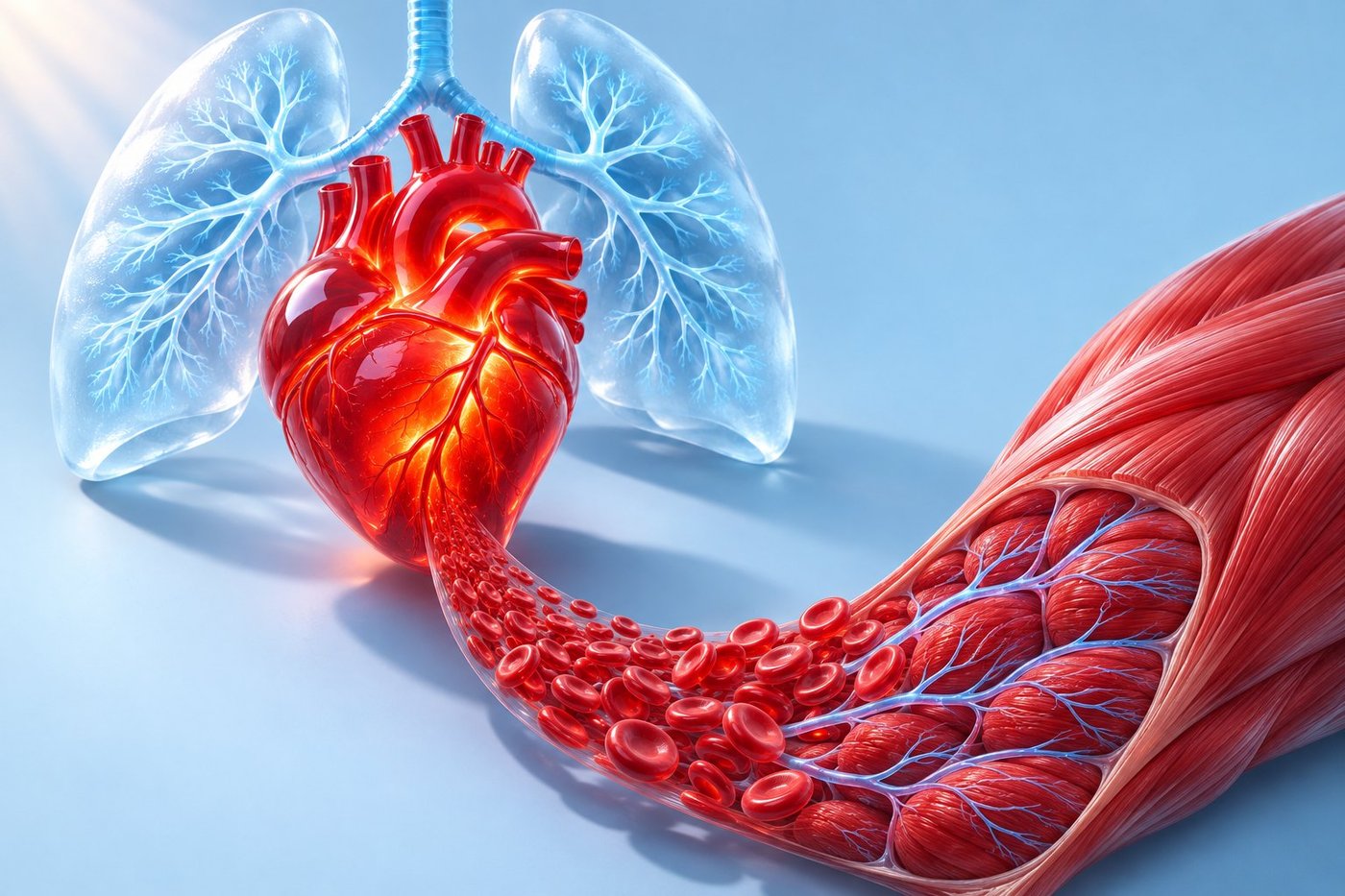
Picture a delivery company with four teams.
- The lungs load the oxygen onto the trucks. Air reaches tiny sacs where oxygen passes into the blood.
- The heart dispatches the trucks. Every beat pushes out a fixed load of blood, and beats a minute times load per beat is your cardiac output, in liters a minute.
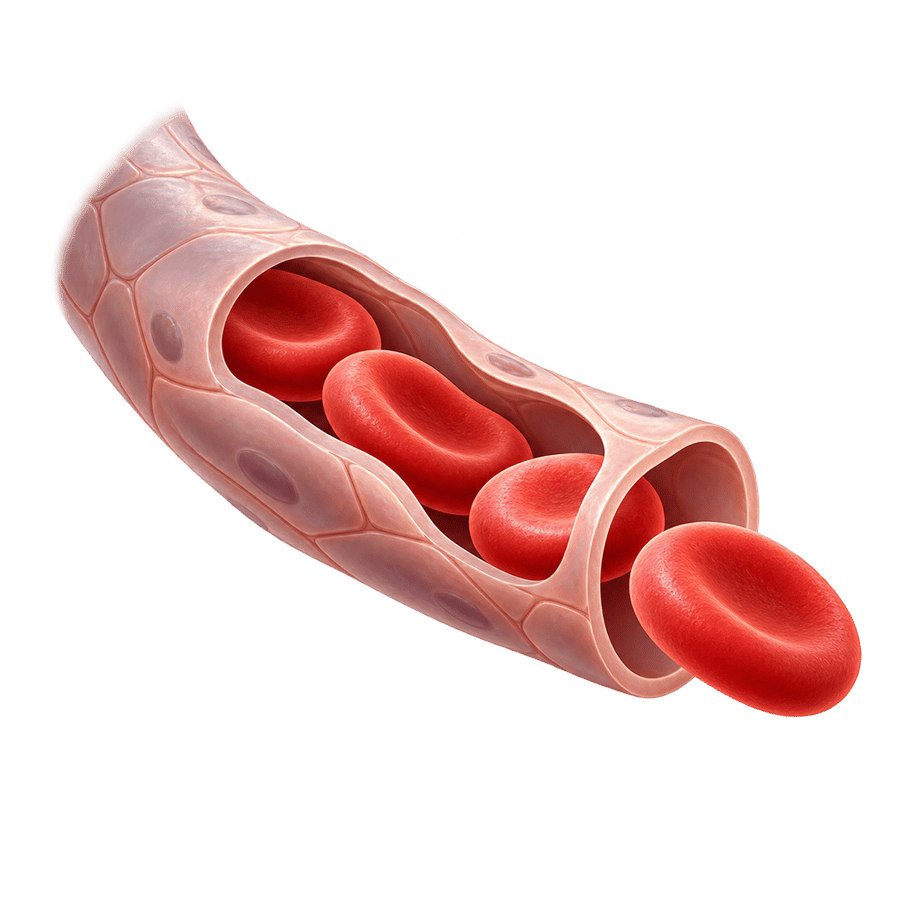
- The red blood cells are the trucks. Each one carries oxygen on hemoglobin, through vessels so narrow the cells squeeze through in single file.
- The muscles unload. Working muscle pulls oxygen out of the blood and burns fuel with it.
VO2 max is the most that whole company can deliver and unload in one minute. Physiologists write it as blood pumped a minute times the share of oxygen the muscles pull out of each liter (the Fick principle).
In 1966, five healthy 20-year-old men were tested in Dallas. At full effort their hearts beat 193 times a minute, pushed out about 104 milliliters of blood each beat and moved about 20 liters a minute. That’s ten 2-liter soda bottles of blood every minute, through a fist-sized pump.
Why is the heart the limit?
A review by the physiologists Bassett and Howley in 2000 laid out three lines of evidence.
- Change the oxygen delivery and VO2 max changes with it. Add blood (blood doping), take away oxygen (altitude), or slow the heart with a beta blocker, and VO2 max moves accordingly.
- Training raises VO2 max mainly through the heart. The rise comes mostly from more blood pumped at maximum, not from muscles pulling out more of the oxygen they already get.
- Muscle has spare room. When a small muscle is given far more blood than usual, it can use an enormous amount of oxygen. In a whole-body effort, then, muscle is waiting on the delivery.
Later trials fit the same picture. In Helgerud’s 2007 trial, 40 moderately trained men did one of four programs three times a week for eight weeks. The two interval groups raised VO2 max, and their stroke volume (the blood pushed out per beat) rose about 10 percent. The changes in VO2 max matched the changes in stroke volume. In a 2017 study of 78 healthy adults, the gain in VO2 max after training was tied most closely to the rise in total hemoglobin, the oxygen-carrying part of the blood.
Thin air shows the same thing from the other side. When eight trained endurance athletes ran in a pressure chamber set to different altitudes, their VO2 max fell 6.3 percent for every 1,000 meters, starting from as low as 800 meters (about 2,600 feet). Their legs and hearts were the same. Each liter of blood carried less oxygen.
Where does the heart story stop being true?
It describes healthy, mostly young people well. It’s not the whole story for everyone.
In the Dallas men, the heart held up surprisingly well as they aged. Thirty years later, at 50, their maximum cardiac output was the same as at 20, because each beat pushed out more blood while their top heart rate fell. Their VO2 max fell because their muscles pulled less oxygen out of each liter. And when they trained for six months at 50, the gain came from the muscles again, not from the heart pumping more.
Muscle also counts for a lot below the maximum. Endurance training raises the enzymes in your muscle’s mitochondria, which helps you burn fat and make less lactic acid at a given pace (Bassett and Howley). That’s why two people with the same VO2 max can race very differently. VO2 max is the ceiling, and how close to it you can hold for an hour is a separate skill.
In people with obesity, a 2025 review found that low fitness often comes from both ends at once, with the heart and the muscle each working less well (Liu and colleagues).
Why per kilogram?
A bigger body has a bigger engine. A 6-foot-4 man will use more liters of oxygen than a 5-foot woman almost by default. Dividing by body weight makes people comparable and fits what you feel, because you carry your whole weight up every hill.
It works like power-to-weight in cars. A small hatchback and a pickup truck can feel equally quick if the horsepower per pound is the same. Your liters of oxygen a minute are the horsepower and your weight is the car.
The catch is that the number moves when your weight does, even if your heart doesn’t. The same Dallas men used 3.3 liters a minute at 77 kg when they were 20, which is 43 ml/kg/min. At 50 they used 2.9 liters at 100 kg, which is 31. The engine lost 11 percent and the per-kilogram number lost 28 percent. More in weight and VO2 max.
What are METs, and is VO2 peak the same thing?
- METs. One MET is the oxygen you use sitting still, set at 3.5 ml/kg/min. A VO2 max of 35 is 10 METs. Big health studies often report fitness in METs. Each 1 MET higher, across 33 studies, went with 13 percent lower risk of death, which is roughly the difference between jogging at one speed and jogging 1 km/h (0.6 mph) faster.
- VO2 peak. The highest oxygen use reached in a test. Strictly, VO2 max means the oxygen stopped rising even as the work got harder, and many people stop before that plateau shows. The US FRIEND chart reports peak values from tests where people worked hard enough by a breathing measure (an exchange ratio of 1.0 or more). In the Generation 100 trial of people in their 70s, 41 percent didn’t meet the full criteria for a maximum, so the researchers called it peak. For your purposes, treat them as the same number.
- Liters a minute. The engine without the car. It’s the number to watch if you want to see training apart from any change in weight.
Typical numbers
| Men | Women | |
|---|---|---|
| The US middle in your 20s | 46.5 | 36.6 |
| The US middle in your 40s | 35.3 | 25.7 |
| The US middle in your 60s | 24.6 | 19.6 |
| The US middle in your 80s | 17.6 | 15.4 |
| Where living on your own gets hard | about 18 | about 15 |
From 16,278 US treadmill tests (FRIEND 2022), in ml/kg/min. What good looks like has the full chart and the percentiles, and why it matters has what each step up has gone with.
13 sources
- Bassett DR and Howley ET, Limiting factors for maximum oxygen uptake and determinants of endurance performance, Medicine and Science in Sports and Exercise, 2000europepmc.org
- Bassett DR, Scientific contributions of A. V. Hill: exercise physiology pioneer, Journal of Applied Physiology, 2002europepmc.org
- Helgerud J and others, Aerobic high-intensity intervals improve VO2max more than moderate training, Medicine and Science in Sports and Exercise, 2007europepmc.org
- Montero D and Lundby C, Refuting the myth of non-response to exercise training: non-responders do respond to higher dose of training, Journal of Physiology, 2017europepmc.org
- McGuire DK and others, A 30-year follow-up of the Dallas Bedrest and Training Study: I. Effect of age on the cardiovascular response to exercise, Circulation, 2001europepmc.org
- McGuire DK and others, A 30-year follow-up of the Dallas Bedrest and Training Study: II. Effect of age on cardiovascular adaptation to exercise training, Circulation, 2001europepmc.org
- Liu Z, Weeldreyer NR and Angadi SS, Incretin receptor agonism, fat-free mass, and cardiorespiratory fitness: a narrative review, Journal of Clinical Endocrinology and Metabolism, 2025pmc.ncbi.nlm.nih.gov
- Kaminsky LA and others, Updated reference standards for cardiorespiratory fitness measured with cardiopulmonary exercise testing (FRIEND), Mayo Clinic Proceedings, 2022mayoclinicproceedings.org
- Stensvold D and others, Effect of exercise training for five years on all cause mortality in older adults, the Generation 100 study: randomised controlled trial, BMJ, 2020pmc.ncbi.nlm.nih.gov
- Mandsager K and others, Association of cardiorespiratory fitness with long-term mortality among adults undergoing exercise treadmill testing, JAMA Network Open, 2018pmc.ncbi.nlm.nih.gov
- Kodama S and others, Cardiorespiratory fitness as a quantitative predictor of all-cause mortality and cardiovascular events in healthy men and women: a meta-analysis, JAMA, 2009europepmc.org
- Shephard RJ, Maximal oxygen intake and independence in old age, British Journal of Sports Medicine, 2009europepmc.org
- Wehrlin JP and Hallén J, Linear decrease in VO2max and performance with increasing altitude in endurance athletes, European Journal of Applied Physiology, 2006europepmc.org