How to increase VO2 max naturally
On this page
Your body raises its own VO2 max whenever you ask your heart to pump near its top, and everyday movement can do the asking. If you want to, and if you can, walk briskly most days and use stairs and hills as your hard minutes. You don’t need a gym, a supplement or a mask.
What we’d do
Walk briskly most days, fast enough that you breathe a little harder but can still talk, about 100 steps a minute. Three days a week, add a few hard climbs, like a flight of stairs taken fast three times, or a steep hill walked hard for a few minutes and strolled back down. Ride a bike for errands if you can. When all of that feels easy, add the 4x4 from how to raise it. Leave the beet juice and the gadgets until then, since none of them grows the engine.
If you remember three things
- Your heart grows to meet the work. Training raises VO2 max mainly by raising how much blood the heart pumps, and walking does that for people starting from a low base.
- Stairs and hills are free intervals. Three 20-second stair climbs, three days a week, raised VO2 max 12 percent in six weeks in 12 young women who didn’t exercise.
- Beet juice and masks don’t add to it. Across 73 studies, nitrate made exercise a little cheaper in oxygen but didn’t change VO2 max, and a training mask added nothing to the same training without it.
Why people look for a shortcut
VO2 max sounds like a lab number, so it seems like raising it should take lab-grade help. A beet juice shot before a run, a mask that claims to simulate altitude, a breathing gadget, a gym membership, or a weight-loss drug that makes the watch number jump. The ads push that way, and so does a watch that hands you a number with a decimal point.
Your engine adapts the way your hands grow calluses. Your heart, blood and muscles get better at whatever you ask of them. Ask them to move a lot of oxygen a few times a week and they build up to it. Stop asking and they let it go. Seven endurance-trained people who stopped completely lost 16 percent of their VO2 max in eight weeks (Coyle, 1984).
How your body raises it on its own
In healthy people, the limit on VO2 max is how much oxygen the heart and blood can deliver, and training raises it mainly by raising how much blood the heart pumps in a minute (Bassett and Howley, 2000). Your lungs have room to spare, which is why breathing exercises don’t raise it.
What makes the heart adapt is time spent near its top output. In the 2007 Norwegian trial, each heartbeat pushed out about 10 percent more blood after eight weeks of hard 4-minute intervals, and VO2 max rose with it. A walk that’s easy stops asking anything after a few weeks. A walk up a hill, or a flight of stairs taken fast, asks a lot. So the natural route has the same two layers as the gym version, plenty of steady movement and a few minutes that are hard.
The steady layer is a brisk walk
For someone who mostly sits, a brisk walk is real work for the heart. In 2007, researchers pooled 24 randomized trials of walking programs, and in people who hadn’t been active, walking raised VO2 max. Can walking raise your VO2 max? has the detail.
Brisk has a number. In a lab study of 76 healthy adults aged 21 to 40, about 100 steps a minute was the line for moderate effort and about 130 for vigorous (Tudor-Locke, 2019). Count your steps for 15 seconds and multiply by four. If you get 100 or more, you’re there. The US guideline asks for at least 150 minutes a week of moderate activity, which is a 30-minute walk five days a week.
A bike counts just as much. In a Danish trial, 130 inactive adults aged 20 to 45 with overweight were assigned to cycle to work, to exercise in their free time, or to carry on as before, for six months. Fitness rose in every exercise group compared with the people who didn’t change, and it rose most in the group that went hardest (Blond, 2019).
The hard minutes are stairs and hills
You don’t need a track for the hard part. You need something that makes you breathe too hard to talk for a minute or more.
Stairs. At McMaster University in Canada, 12 young women who didn’t exercise ran up stairs as fast as they could for 20 seconds, three times with rest between, three days a week. After six weeks their VO2 max was up 12 percent, about 3.5 points, and each session took about 10 minutes with the warm-up. A version with 60 seconds of going up and down one flight raised it 7 percent (Allison, 2017). In a second study, young adults who had been inactive climbed a 60-step, three-flight stairwell fast three times a day, a few hours apart, three days a week for six weeks. Their VO2 max rose compared with people who didn’t climb, though the researchers called the gain modest (Jenkins, 2019).
These were small studies in young adults, and the first had no comparison group. But they show the stairs at home or at work can be an interval session.
Hills. The same pace costs a lot more uphill. By the American College of Sports Medicine’s walking equation, a 3 mph walk on the flat costs about 11.5 ml/kg/min. Up a 10 percent grade it costs about 26, more than twice as much.
A 3 mph walk, steeper and steeper
For a woman in her 50s at the US middle of about 23, a 3 mph walk up a 5 percent grade takes about 80 percent of her VO2 max, and a 10 percent grade is past it, so she’d slow down on the steep part. For a man in his 50s at the middle, about 29, the 10 percent grade takes about 90 percent. That’s hard-minutes territory with no equipment.
Walk hard up a hill for 4 minutes, stroll down for 3, and do it four times, and you’ve done a 4x4. In Generation 100, people aged 70 to 77 did their hard intervals at about 16 on the 6 to 20 effort scale, twice a week for five years, and none of the groups lost fitness.
What the shortcuts do
Beet juice. The nitrate in beetroot juice makes your muscles use a little less oxygen at the same effort. In a 2021 review of 73 studies with 1,061 people, nitrate improved power and how long people lasted before exhaustion, but it had no significant effect on VO2 max (Gao, 2021). It might help a race a little, and it doesn’t grow the engine.
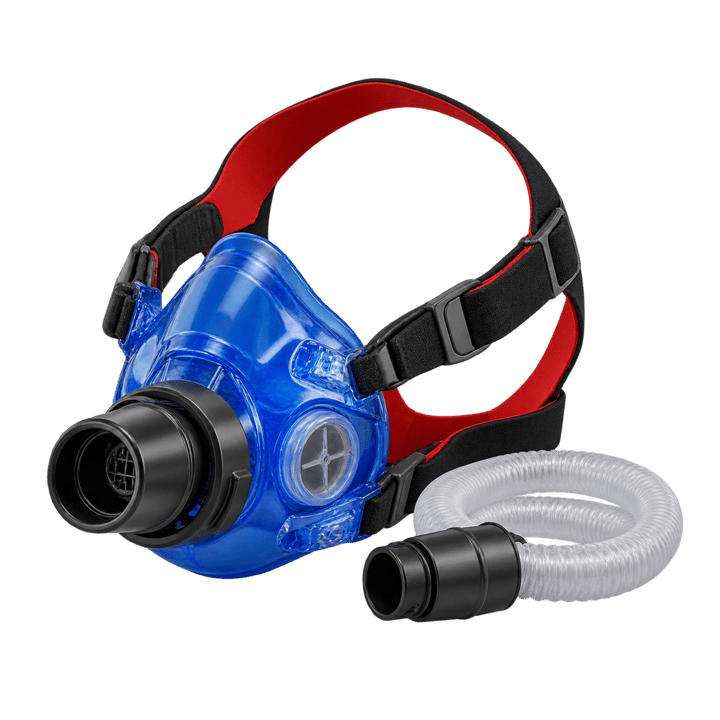
Training masks. Masks sold as altitude simulators make it harder to breathe. In a 2016 trial, 24 moderately trained adults did six weeks of hard cycling, half of them in an Elevation Training Mask. VO2 max rose 13.5 percent without the mask and 16.5 percent with it, a gap the researchers found wasn’t significant. The mask didn’t raise hemoglobin either, which real altitude would, and the researchers concluded it worked like a breathing muscle trainer rather than altitude (Porcari, 2016). The cycling did the work.
Iron. Iron carries the oxygen in your blood, so running low on it holds the engine back. In 18 trials in women of reproductive age, a group where low iron is common, daily iron raised VO2 max by about 2.35 points (Pasricha, 2014). If easy efforts leave you unusually tired and out of breath, ask your doctor to check your iron rather than buying a bottle.
Weight-loss drugs. On a GLP-1 drug like Ozempic, the per-kilogram number rises as the weight falls. But 25 to 40 percent of the weight lost is lean mass, and studies so far haven’t shown a gain in fitness. Losing weight with food and movement raises the number the same way, and the movement grows the engine too. Does losing weight raise your VO2 max? has the math, and does Ozempic lower VO2 max? has the drugs.
If you can’t do all of it
Not everyone can take stairs fast or walk up a steep hill. Knees, hearts and lungs differ, and that’s fine. Start where you are, with a slower walk, a flat route, a stationary bike or a pool. The first step up from low fitness is where the health gain is biggest. In 33 studies of more than 100,000 people, each extra MET of fitness (3.5 points) went with 13 percent lower risk of death (Kodama, 2009).
If you’ve been mostly sitting, or you have chest pain or a heart condition, read is it safe to push hard? before the hard minutes, and talk to your doctor. On a beta blocker, go by effort, not heart rate. See heart rate zones on a beta blocker.
Then what
Test yourself before you start and again after 8 to 12 weeks, the same way each time. The 1-mile walk test needs only a measured mile and your heart rate at the finish, and where you stand ranks the result for your age. When the walks and stairs feel easy, add the 4x4 with your own heart rate band and the timer. The whole plan, from the first walk to tracking it, is at the end of how to increase your VO2 max at any age.
18 sources
- Bassett DR and Howley ET, Limiting factors for maximum oxygen uptake and determinants of endurance performance, Medicine and Science in Sports and Exercise, 2000europepmc.org
- Helgerud J and others, Aerobic high-intensity intervals improve VO2max more than moderate training, Medicine and Science in Sports and Exercise, 2007europepmc.org
- Murphy MH and others, The effect of walking on fitness, fatness and resting blood pressure: a meta-analysis of randomised, controlled trials, Preventive Medicine, 2007europepmc.org
- Tudor-Locke C and others, Walking cadence (steps/min) and intensity in 21-40 year olds: CADENCE-adults, International Journal of Behavioral Nutrition and Physical Activity, 2019pmc.ncbi.nlm.nih.gov
- Centers for Disease Control and Prevention, Adult activity: an overview, checked 2026-11-15cdc.gov
- Blond MB and others, How does 6 months of active bike commuting or leisure-time exercise affect insulin sensitivity, cardiorespiratory fitness and intra-abdominal fat? A randomised controlled trial in individuals with overweight and obesity, British Journal of Sports Medicine, 2019europepmc.org
- Allison MK and others, Brief intense stair climbing improves cardiorespiratory fitness, Medicine and Science in Sports and Exercise, 2017europepmc.org
- Jenkins EM and others, Do stair climbing exercise snacks improve cardiorespiratory fitness?, Applied Physiology, Nutrition, and Metabolism, 2019europepmc.org
- Jang WY, Kang DO and others, Validation of FRIEND and ACSM equations for cardiorespiratory fitness: comparison to direct measurement in CAD patients (the ACSM walking equation, Table 1), Journal of Clinical Medicine, 2020pmc.ncbi.nlm.nih.gov
- Kaminsky LA and others, Updated reference standards for cardiorespiratory fitness measured with cardiopulmonary exercise testing (FRIEND), Mayo Clinic Proceedings, 2022mayoclinicproceedings.org
- Stensvold D and others, Effect of exercise training for five years on all cause mortality in older adults, the Generation 100 study: randomised controlled trial, BMJ, 2020pmc.ncbi.nlm.nih.gov
- Gao C and others, The effects of dietary nitrate supplementation on endurance exercise performance and cardiorespiratory measures in healthy adults: a systematic review and meta-analysis, Journal of the International Society of Sports Nutrition, 2021pmc.ncbi.nlm.nih.gov
- Porcari JP and others, Effect of wearing the Elevation Training Mask on aerobic capacity, lung function, and hematological variables, Journal of Sports Science and Medicine, 2016pmc.ncbi.nlm.nih.gov
- Pasricha SR and others, Iron supplementation benefits physical performance in women of reproductive age: a systematic review and meta-analysis, Journal of Nutrition, 2014europepmc.org
- Liu, Weeldreyer and Angadi, GLP-1 drugs, lean mass and cardiorespiratory fitness, 2025pmc.ncbi.nlm.nih.gov
- Kodama S and others, Cardiorespiratory fitness as a quantitative predictor of all-cause mortality and cardiovascular events in healthy men and women: a meta-analysis, JAMA, 2009europepmc.org
- Coyle EF and others, Time course of loss of adaptations after stopping prolonged intense endurance training, Journal of Applied Physiology, 1984europepmc.org
- Riebe D and others, Updating ACSM's recommendations for exercise preparticipation health screening, Medicine and Science in Sports and Exercise, 2015europepmc.org