How to increase your VO2 max at any age
On this page
VO2 max is the size of your engine, the most oxygen your body can use in a minute when you go flat out. It predicts how long you’ll live about as strongly as smoking does, it shrinks every decade, and it grows at any age. Cardio most days, one or two hard sessions a week and 8 to 12 weeks of patience will raise it.
What we’d do
Build the week in two layers. Most days, walk briskly, ride, row or run at a pace where you can still talk, at least the 150 minutes a week the US guideline asks for. Once or twice a week, make one of those sessions hard: four 4-minute efforts that leave you breathing too hard to chat, with 3 easy minutes between. Retest the same way after 8 to 12 weeks.
After 40, count holding steady as a win, because the chart drops about 4 points a decade underneath you. A man who keeps a VO2 max of 42 from 45 to 65 climbs from the 73rd percentile for his age to the top 10 percent without getting any fitter.
If you remember three things
- The heart is the engine, and it trains. In healthy people the heart’s output sets the ceiling, and in the 4x4 trial each beat pushed out about 10 percent more blood after eight weeks.
- Steady cardio builds most of it, and hard minutes add the rest. Across 28 trials, steady training added 4.9 points and intervals 5.5.
- Your watch is a rough ruler. Apple Watch Series 10 came in 6.25 points low on average in a lab check. Check it once against a real test, then compare it only with itself.
You own a supercar, and you drive it in first gear
Picture someone handing you the keys to a V12 supercar, the kind with more horsepower than you’ll ever need and a price north of $400,000. It’s yours. There’s one rule. You can only ever drive it in first gear. You never get the open road, never touch the redline, and never find out what it can do.
That’s how most of us live in our own bodies. Your heart, lungs and muscles are an engine too, and VO2 max is its power rating. A dyno tells you how much power a car makes at full throttle, and a VO2 max test tells you how much oxygen your body can use when it’s going flat out.
Unlike the car, your engine gets bigger the more you use it. You don’t need a pit crew or race fuel. You need to take it out of first gear a few times a week, hard enough to feel it.
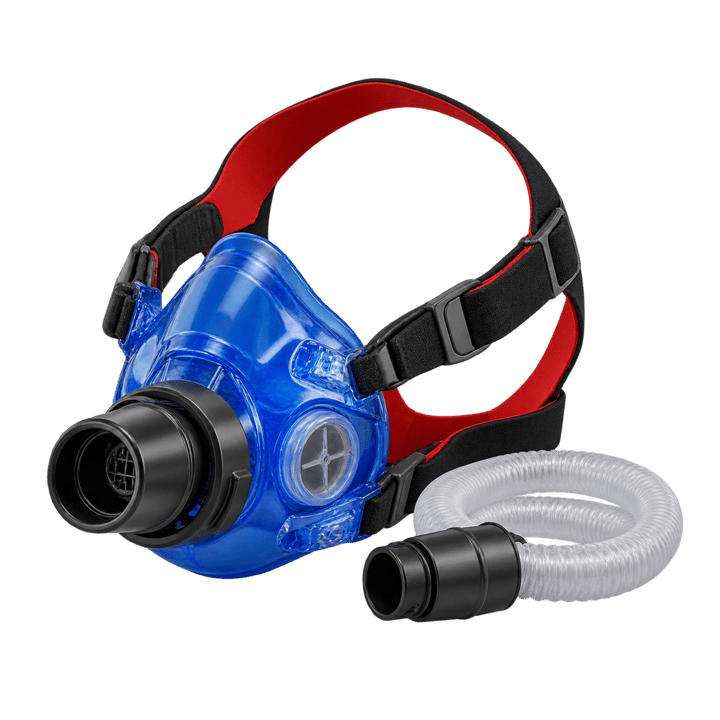
You don’t need a gym for that either. If you want to, and if you can, start the natural way, with brisk walks most days and a few fast flights of stairs or a steep hill a few times a week. In one small study, three 20-second stair climbs, three days a week, raised VO2 max 12 percent in six weeks. No supplement, mask or gadget has been shown to grow the engine. How to increase VO2 max naturally has the studies.
What exactly is the engine?
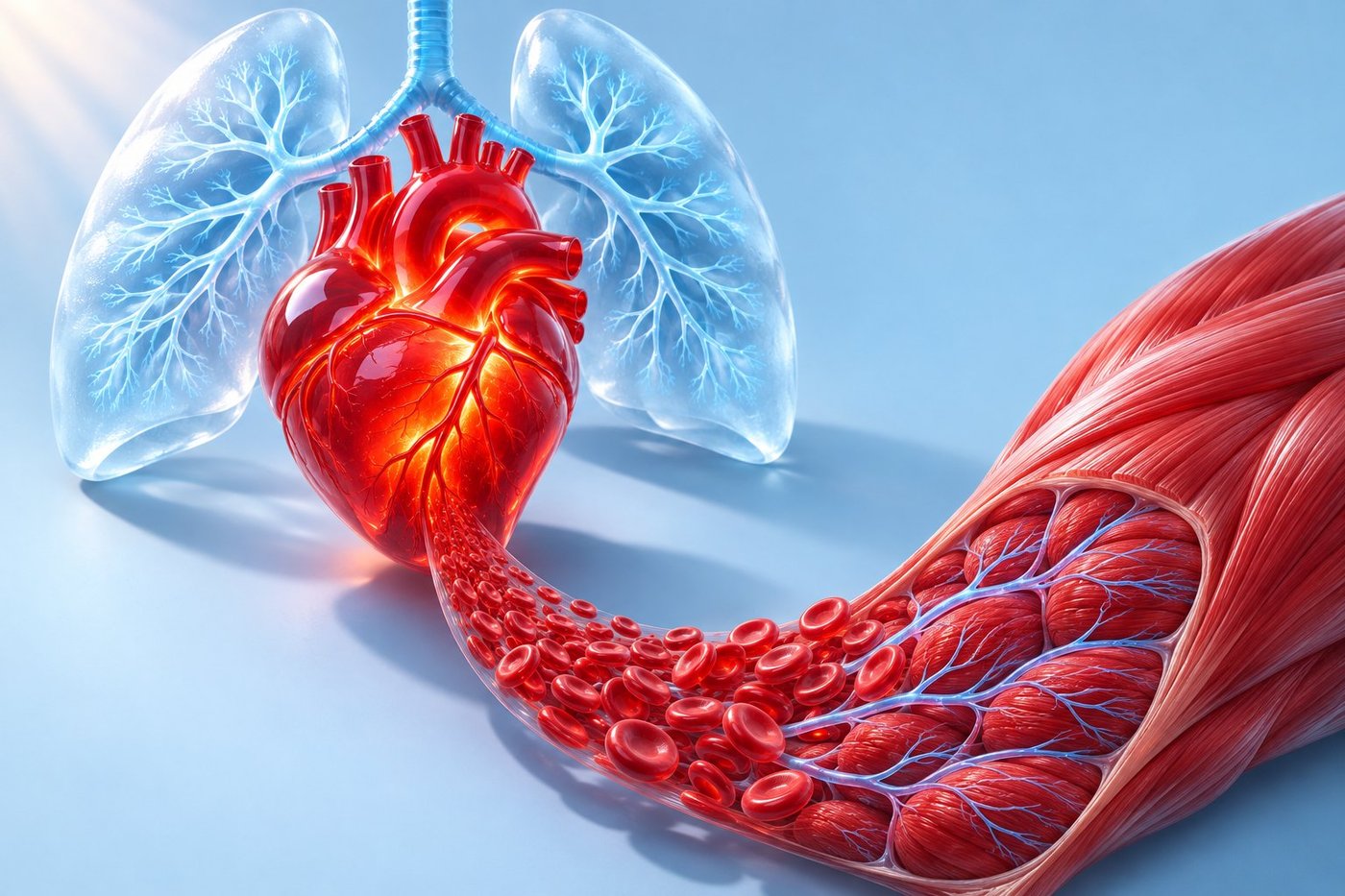
When you exercise, your lungs load your blood with oxygen, your heart pumps it out, red blood cells carry it through vessels finer than a hair, and your working muscles pull it out and burn fuel with it. VO2 max is the most oxygen that whole chain can deliver and use in a minute.
The heart decides it. In healthy people the limit is how much oxygen the heart and blood can deliver, and training raises VO2 max mainly by raising how much blood the heart pumps in a minute (Bassett and Howley, 2000). Healthy lungs have room to spare, which is why breathing drills don’t raise it.
The number is usually given per kilogram of you (ml/kg/min), which makes it a power-to-weight ratio, like horsepower per ton. Five men in Dallas used 3.3 liters of oxygen a minute at 20 and 2.9 at 50, a loss of 11 percent, but their weight went from 77 to 100 kg, so their number fell from 43 to 31. What VO2 max measures has the whole chain.
How do you make the engine bigger?
There’s a fight online between two camps. One says go slow, stay in zone 2 and log the hours. The other says long easy sessions are a waste and short, brutal intervals are all you need. Both are holding half the answer, and you want both layers.
This is our sample week, not a trial’s. It clears the US guideline’s 150 minutes, and it fits the two hard sessions a week that people in their 70s kept up for five years in Norway.
The first layer is steady cardio most days. A pace where you can still talk, on whatever you’ll keep doing. When researchers pooled 28 controlled trials in 723 healthy adults, steady endurance training raised VO2 max by 4.9 ml/kg/min against no exercise (Milanović 2015). That’s enough to take a man in his 40s from the middle of the chart to about the 68th percentile, from walking, riding or jogging at a chatting pace.
The second layer is the hard minutes. Warm up, then 4 minutes at 90 to 95 percent of your max heart rate and 3 minutes easy, four times. In the 2007 trial that made it famous, 40 fit young men did it three times a week for eight weeks and their VO2 max rose 7.2 percent, from 55.5 to 60.4. Two groups who did the same total work at a steady pace didn’t improve significantly. In the 28 pooled trials, intervals came out 1.2 points ahead of steady work.
The hard minutes work because they keep your heart near its top output long enough to push it to adapt. In the 4x4 trial the men’s stroke volume, the blood pushed out per beat, rose about 10 percent after the intervals, and the rise in VO2 max matched it. Think of steady cardio as carrying groceries every day and the 4x4 as the heavy weight on the bar. You need both to get strong.
How to raise it has the session in detail, the week for every starting point and what to do if you don’t improve. Your heart rate zones works out your bands, and the 4x4 timer runs the session.

What should you expect, and when?
- Weeks 1 to 4Build the steady layer. If you’ve been mostly sitting, walk briskly for a month before the first hard session.
- Week 6In a 2017 study, 78 adults trained 1 to 5 hours a week for six weeks. The more they did, the fewer failed to improve, and everyone who hadn’t improved did once they added two more hours a week.
- Week 8The 4x4 group in the famous trial was up 7.2 percent after three sessions a week.
- By week 13Across 37 interval studies of 6 to 13 weeks in sedentary or lightly active adults under 45, VO2 max rose about half a liter a minute, about 6 points for someone who weighs 176 lb.
- Month 6Five Dallas men at 50 won back all the oxygen use they’d lost in 30 years.
- Year 51,567 people aged 70 to 77 who trained twice a week lost nothing, against an expected drop of 3.5 points.
People do differ. In the HERITAGE study, 481 sedentary adults did the same 20-week program and gained about 400 milliliters a minute on average, but some gained almost nothing and others more than a liter, and families tended to respond alike. If yours is slow to move, add a session before you blame your genes. VO2 max is mostly genes has the rest.
It goes the other way faster than you’d like. Seven endurance-trained people stopped completely and lost 7 percent in three weeks and 16 percent by eight, though they stayed fitter than people who had never trained (Coyle 1984). A week off for a cold costs very little. A season off costs a lot.
How much VO2 max do you need?
Everything you do costs oxygen, and the Compendium of Physical Activities lists the measured cost of more than a thousand activities. Carrying groceries upstairs costs about 19 ml/kg/min. Climbing stairs at a normal pace costs about 24. A 10-minute mile costs about 33. The closer a task sits to your VO2 max, the harder it feels and the sooner you have to stop, and anything above it you can only do in a short burst.
The floor to stay above is about 18 for men and 15 for women. The physiologist R. J. Shephard found that below it, living on your own gets hard, and most people reach it at 80 to 85. Apple uses the same line for its low-fitness alert from age 60. We’d aim well above it, out of the bottom quarter for your age, where the Cleveland Clinic study found the most risk, and into the top half. The minimum VO2 max you want has the whole ladder.
Why does it fall as you get older?
Your top heart rate falls about 7 beats a decade, and in Tanaka’s analysis of 18,712 people it fell the same way in active and inactive people. Your muscles pull less oxygen out of each liter of blood, and most of us carry more weight and move less. In 810 healthy adults retested over about 8 years, VO2 max fell 3 to 6 percent a decade in their 20s and 30s and more than 20 percent a decade in their 70s, at every level of activity (Fleg 2005).
That’s why holding steady counts as climbing. The chart drops underneath you, so a number that stays put moves you up the ranks. And the slope bends with training. The Dallas men won back 30 years in six months, and Norway’s 70-somethings held theirs flat for five years. Why VO2 max falls with age has the mechanisms and the bed rest story.
How do you know your real number?
Only a lab test with a mask measures VO2 max. Everything else estimates it, and the estimate is only as good as what you feed it.
- Your watch. It guesses from your heart rate at a known pace. Apple Watch Series 10 came in 6.25 points low on average and put only 5 of 35 people in their right fitness band. Garmin-style watches came out right on average, give or take about 5. Getting an accurate number from your watch has the workouts that feed it clean data.
- A test you run. A 12-minute run, a 1.5-mile run, a fast mile walk or a treadmill climb, each with its published formula. Test it yourself does the math, and how to measure it compares every method.
- A sanity check. If your watch says 45, a real 45 can run 1.5 miles in about 11:38. What a real VO2 max can do has the field results and everyday tasks for every number.
- Your true VO2 max. The quiz takes your watch number, asks about stairs, your pace and any test you’ve timed, and gives you the probable range with the reasoning.
Then see what’s good for your age and why it predicts how long you live.
The map
What do most people get wrong?
- They take the watch number as exact. No watch measures oxygen. It guesses from your heart rate at a pace, and in the Series 10 study only 5 of 35 people landed in their right band. See your watch knows your VO2 max.
- They think it’s set by genes and age. Genes shape how fast you respond, and age pulls everyone down, but the Dallas men trained their way back to the oxygen use they had at 20 in six months. See after 60 it’s too late.
- They pick a side, zone 2 or intervals. Steady training added 4.9 points across 28 trials and intervals 5.5, so you want both. See zone 2 is the best way to raise it.
The simple plan
If you’re a normal, healthy adult who wants a bigger engine and wants to keep it, this is all of it, in order.
- Move more in your normal day first, if you want to and if you can. Brisk walks most days at about 100 steps a minute, a bike for errands, and stairs or a steep hill taken hard a few times a week. That’s the natural route, and it builds both layers with no gym. How to increase VO2 max naturally
- Get one number, then check it. Use your watch, or time a 12-minute run or a fast mile walk with test it yourself. If your watch says 45, a real 45 can run 1.5 miles in about 11:38, and the true VO2 max quiz puts your watch, your stairs and your test together.
- Build the steady layer. At least 150 minutes a week at a pace where you can still talk, on whatever you’ll keep doing. exercise.guide covers how much cardio counts, and strength.guide how it fits with lifting.
- Add the hard minutes once or twice a week. Four 4-minute efforts that leave you breathing too hard to chat, with 3 easy minutes between. Work out your band with your heart rate zones and run it with the 4x4 timer. If you’ve been mostly sitting, or you have chest pain or a heart condition, read before you go hard first.
- Track it one way, and retest in 8 to 12 weeks. Same watch or same test, same conditions. Believe a change of more than 2 to 4 points, since in Apple’s own data one person’s estimates typically wobble by about 1.2 points from one to the next. Your Apple Watch, Garmin or Oura sends your VO2 max to Gyroscope on its own, and Gyroscope One trends it over months against your age group and scores it in your Health Score. More on tracking it in Gyroscope.
- Hold it as the years pass. A typical target is the top half for your decade, held as you age, and after 40 a number that stays put climbs the ranks. The Gyroscope app personalizes yours. What fitness means in years of life is lifespan.guide’s subject.
- If it doesn’t move, add a session before you blame your genes. In the 2017 study, everyone who hadn’t improved after six weeks did once they added two more hours a week. A week off for a cold costs very little, and a season off costs a lot.
Every study behind this guide, one plain line each, is on VO2 max studies, tips and resources.
23 sources
- Bassett DR and Howley ET, Limiting factors for maximum oxygen uptake and determinants of endurance performance, Medicine and Science in Sports and Exercise, 2000europepmc.org
- Helgerud J and others, Aerobic high-intensity intervals improve VO2max more than moderate training, Medicine and Science in Sports and Exercise, 2007europepmc.org
- Milanović Z, Sporiš G and Weston M, Effectiveness of high-intensity interval training and continuous endurance training for VO2max improvements: a systematic review and meta-analysis of controlled trials, Sports Medicine, 2015europepmc.org
- Bacon AP and others, VO2max trainability and high intensity interval training in humans: a meta-analysis, PLOS ONE, 2013pmc.ncbi.nlm.nih.gov
- Montero D and Lundby C, Refuting the myth of non-response to exercise training: non-responders do respond to higher dose of training, Journal of Physiology, 2017europepmc.org
- Bouchard C and others, Familial aggregation of VO2max response to exercise training: results from the HERITAGE Family Study, Journal of Applied Physiology, 1999europepmc.org
- Coyle EF and others, Time course of loss of adaptations after stopping prolonged intense endurance training, Journal of Applied Physiology, 1984europepmc.org
- McGuire DK and others, A 30-year follow-up of the Dallas Bedrest and Training Study: I. Effect of age on the cardiovascular response to exercise, Circulation, 2001europepmc.org
- McGuire DK and others, A 30-year follow-up of the Dallas Bedrest and Training Study: II. Effect of age on cardiovascular adaptation to exercise training, Circulation, 2001europepmc.org
- Stensvold D and others, Effect of exercise training for five years on all cause mortality in older adults, the Generation 100 study: randomised controlled trial, BMJ, 2020pmc.ncbi.nlm.nih.gov
- Fleg JL and others, Accelerated longitudinal decline of aerobic capacity in healthy older adults, Circulation, 2005europepmc.org
- Tanaka H, Monahan KD and Seals DR, Age-predicted maximal heart rate revisited, Journal of the American College of Cardiology, 2001europepmc.org
- Kaminsky LA and others, Updated reference standards for cardiorespiratory fitness measured with cardiopulmonary exercise testing (FRIEND), Mayo Clinic Proceedings, 2022mayoclinicproceedings.org
- Mandsager K and others, Association of cardiorespiratory fitness with long-term mortality among adults undergoing exercise treadmill testing, JAMA Network Open, 2018pmc.ncbi.nlm.nih.gov
- Shephard RJ, Maximal oxygen intake and independence in old age, British Journal of Sports Medicine, 2009europepmc.org
- Herrmann SD and others, 2024 Adult Compendium of Physical Activities: a third update of the energy costs of human activities, Journal of Sport and Health Science, 2024pmc.ncbi.nlm.nih.gov
- Lambe R and others, Accuracy of VO2 max estimates from Apple Watch Series 10, Mayo Clinic Proceedings: Digital Health, 2026pmc.ncbi.nlm.nih.gov
- Apple, Using Apple Watch to estimate cardio fitness with VO2 max, May 2021apple.com
- Molina-Garcia P and others, Validity of estimating the maximal oxygen consumption by consumer wearables: a systematic review with meta-analysis and expert statement of the INTERLIVE network, Sports Medicine, 2022pmc.ncbi.nlm.nih.gov
- Riebe D and others, Updating ACSM's recommendations for exercise preparticipation health screening, Medicine and Science in Sports and Exercise, 2015europepmc.org
- Centers for Disease Control and Prevention, Adult activity: an overview, checked 2026-11-15cdc.gov
- Allison MK and others, Brief intense stair climbing improves cardiorespiratory fitness, Medicine and Science in Sports and Exercise, 2017europepmc.org
- Tudor-Locke C and others, Walking cadence (steps/min) and intensity in 21-40 year olds: CADENCE-adults, International Journal of Behavioral Nutrition and Physical Activity, 2019pmc.ncbi.nlm.nih.gov